Follow Me

Showing posts with label space shuttle. Show all posts

Thursday, July 21, 2011

The Graceful End To The Shuttle Program

At 5:57 EST this morning, Atlantis touched down at NASA's Kennedy Space Center for the last time.  It was a sad, yet glorious moment in the nation's history, as the Space Shuttle program is officially over.  After 30 years in service, and coincidentally on the 42nd anniversary of the moon landing, the ship came home after a journey of 5,284,862 miles.


As she landed, Shuttle commander Capt. Christopher J. Ferguson said, "Mission complete, Houston.  After serving the world for over 30 years, the space shuttle has earned it's place in history, and it’s come to a final stop."  He then thanked Columbia, Challenger and the other Shuttles in the fleet for their contributions to space exploration.  I would be lying if I said I didn't get a bit choked up.


The video, though a bit long, is amazing to watch.  For the first time that I've seen, it includes the landing from the perspective of inside Atlantis.  This isn't like landing a 747.  When it entered our atmosphere, Atlantis was traveling at nearly 4,000 miles per hour.  She has no engines and is pointing down at an angle seven times steeper than that of a commercial airliner.  The Shuttle has been described as a "flying brick".  There are no second chances at landing it.  It's not as if they're able to loop it back around Kennedy for another attempt.  For as "simple" as it is, it's an engineering and technological marvel.

The Shuttle captured our imaginations and made the search for the unknown a priority in our country again.  If not for the Shuttle, the Hubble telescope would not have been possible.  Neither would countless imaging and communications satellites.  The Shuttle program is directly responsible for our new found understanding of the galaxy and universe around us.

I remember the moment Challenger broke apart, while I was watching it with my fifth grade classmates.  I remember the Saturday morning of February 1, 2003, when I was awoken by a phone call, telling me that Columbia had disintegrated in the skies over Texas.  It has been a tumultuous 30 years, to say the least.  As someone that wanted to be an astronaut as a little boy, I couldn't help but get a little emotional hearing the twin sonic booms for the last time during Atlantis' reentry.  It makes me so unimaginably proud to be an American.
Saturday, July 16, 2011

Video: See A Once In A Lifetime Shot Of Atlantis' Final Launch

Earlier this week, NASA released video of the final launch of the Space Shuttle Atlantis, taken from cameras placed in various locations on the solid rocket boosters.  The series of clips run a little over a half an hour long, but provide a number of "Oh, wow" moments.  To see Atlantis pull away as the boosters start to fall back to earth is awe inspiring.  Simply beautiful footage.

Carl Sagan On The End Of The Shuttle Era

A beautiful, inspiring and thought provoking send off from the hereafter.

Saturday, April 23, 2011

Better Than Having A Front Seat On The Ground

There are only two Shuttle launches left before the fleet is retired and sent to their respective resting places.  Endeavour is set to launch this week on the 29th, and Atlantis will launch from Kennedy Space Center on June 28.  Atlantis' launch will be the 135th, and final, launch of the Space Shuttle's tumultuous 30 year history.

On the morning of February 24, 2010, the Space Shuttle Discovery made it's final flight into orbit above Earth.  The passengers on an airline flight from Orlando, Florida, saw the launch from a perspective that few others ever get to see.


My favorite part of the video is when the smartass pilot comes on the intercom and says, "For those of you on the right side of the aircraft, you can see the Space Shuttle launching.  For those of you on the left side, you can see the people on the right side looking at the Space Shuttle.".


Obviously, at one point, everyone on the left side of the cabin crowded over to the right, because you can hear someone ask, "Is the plane going to tip over?".  Then, one of the flight attendants comes on and buys a round of drinks for everyone on board.


What an experience.  One of the few times in life when sitting in coach doesn't seem so terrible.

Friday, January 28, 2011

Remembering The Challenger Disaster

There are very few instances in the last 50 years of American history that we can look back upon, and remember, in detail, exactly where we were when it took place.  My parents remember where they were when JFK was assassinated.  Their parents remember when Pearl Harbor was bombed.  My first memory with that kind of historical significance was on January 28, 1986.  

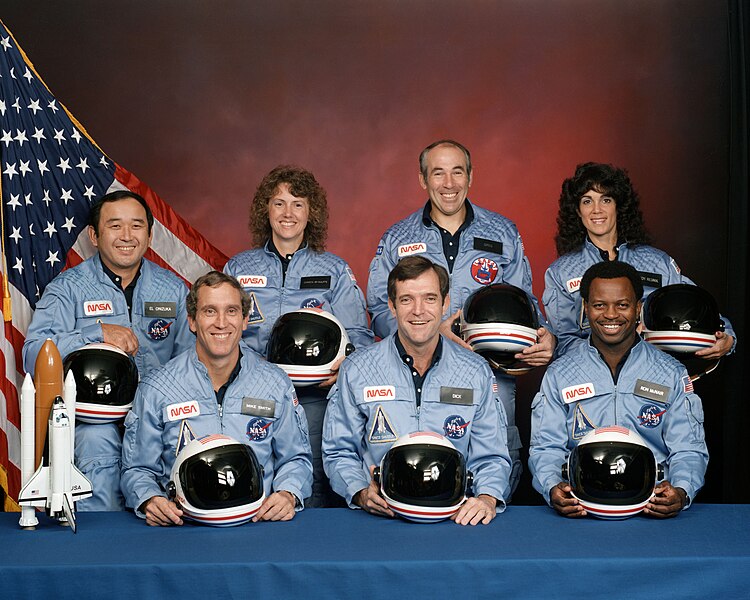
At 11:38am Eastern time, the Space Shuttle Challenger disintegrated over the Atlantic Ocean, one minute and thirteen seconds after launch.  On board were seven astronauts, including Christa McAuliffe, the first teacher in space.


NASA broadcast the launch live to thousands of schools nationwide.  I saw it live on a big screen television in the school library with my fifth grade class.  I was devastated.  I remember the worst part of all was watching McAullife's parent's in the crowd clapping.  They had no idea what was going on.  They had never seen a shuttle launch before.  I started crying.  They didn't know that they had just watched their daughter die.

Fast forward twenty five years.  The final shuttle mission is scheduled for April, NASA's future is in question, and the 25 year anniversary of the Challenger disaster is lucky to get a paragraph mention on page 3 or 4 of today's paper.  These five men and two women pioneered what we find ordinary today.  Without their sacrifice, there may not have been a possibility of "space tourism", the Hubble telescope, or the International Space Station.  We owe them our gratitude and respect.

For a detailed account of what happened on January 28th, 1986, take a look at the Wikipedia article on the Challenger disaster.  There is some interesting, and shocking, information about what happened to the shuttle and the crew during the accident.

Wednesday, October 28, 2009

Memos Regarding The Challenger Disaster

As I've related in previous postings, I follow a blog called Letters of Note. At times, the letters that they come across and post literally give me chills and make me ill. Yesterday's letter was a perfect example.

It was an internal memo from an engineer at a company called Morton Thiokol, to their Vice President. Morton Thiokol was the company that made the O rings for the space shuttles at NASA. This memo, dated July 31st, 1985, stated that there were known erosion issues with the primary and secondary O rings Morton Thiokol were supplying to NASA, and, until the issue could be resolved, all future flights should be suspended because there was a risk of "catastrophe of the highest order - loss of human life".

The memo was, in essence, ignored. Less than six months later, on January 28th, 1986, seven astronauts lost their lives when the Space Shuttle Challenger exploded over Cape Canaveral, Florida, one minute and 18 seconds into its flight. The investigation into the accident concluded that O ring failure on one of the shuttles rocket boosters caused the explosion, which could have easily been prevented if this memo was taken to heart. Below is a photo of the memo itself followed by the transcript:


Transcript

Morton Thiokol, Inc
Wasatch Division

Interoffice Memo

31 July 1985
2870:FY86:073

TO: R. K. Lund
Vice President, Engineering

CC: B. C. Brinton, A. J. McDonald, L. H. Sayer, J. R. Kapp

FROM: R. M. Boisjoly
Applied Mechanics - Ext. 3525

SUBJECT: SRM O-Ring Erosion/Potential Failure Criticality

This letter is written to insure that management is fully aware of the seriousness of the current O-ring erosion problem in the SRM joints from an engineering standpoint.

The mistakenly accepted position on the joint problem was to fly without fear of failure and to run a series of design evaluations which would ultimately lead to a solution or at least a significant reduction of the erosion problem. This position is now drastically changed as a result of the SRM 16A nozzle joint erosion which eroded a secondary O-ring with the primary O-ring never sealing.

If the same scenario should occur in a field joint (and it could), then it is a jump ball as to the success or failure of the joint because the secondary O-ring cannot respond to the clevis opening rate and may not be capable of pressurization. The result would be a catastrophe of the highest order - loss of human life.

An unofficial team (a memo defining the team and its purpose was never published) with leader was formed on 19 July 1985 and was tasked with solving the problem for both the short and long term. This unofficial team is essentially nonexistent at this time. In my opinion, the team must be officially given the responsibility and the authority to execute the work that needs to be done on a non-interference basis (full time assignment until completed.)

It is my honest and very real fear that if we do not take immediate action to dedicate a team to solve the problem with the field joint having the number one priority, then we stand in jeopardy of losing a flight along with all the launch pad facilities.

(Signed)

R. M. Boisjoly

Concurred by:

(Signed)

J. R. Kapp, Manager
Applied Mechanics